Run
Engines
Physics-aware applications perform defined geoscience tasks with transparent configuration and complete scientific evidence.
Methods · physics · full QC
 LithoSightDiscuss a pilot
 LithoSight captures expert judgment, learns from it, and returns that expertise to every asset through physics-based AI engines.
Physics-based AI · Full QC · Expert control · Private deployment
More compute accelerates runs. Experts still decide which results to trust. When the reasoning disappears at project close, the next asset starts again.
One expert review creates a trusted result.
Captured properly, it also teaches future projects.
Foundry is where we build the intelligence. The foundation model and engines are how clients use it.
Physics-aware applications perform defined geoscience tasks with transparent configuration and complete scientific evidence.
Experts inspect results, compare alternatives, correct the work, and record why a result should be trusted.
The model learns from reviewed examples and is evaluated on wells and geological settings it has not seen before.
Validated model guidance returns through the engines, making captured expertise available to future projects.
Capture inputs, results, corrections, and reasoning.
Retain scientific outcomes, QC, and provenance.
Measure transfer on unseen wells and geological settings.
Validated model guidance returns to the engines.
TieSight combines physics-based AI, automated calibration, and complete QC. Foundry keeps the scientific evidence and expert decision linked so the feedback can become learning evidence.
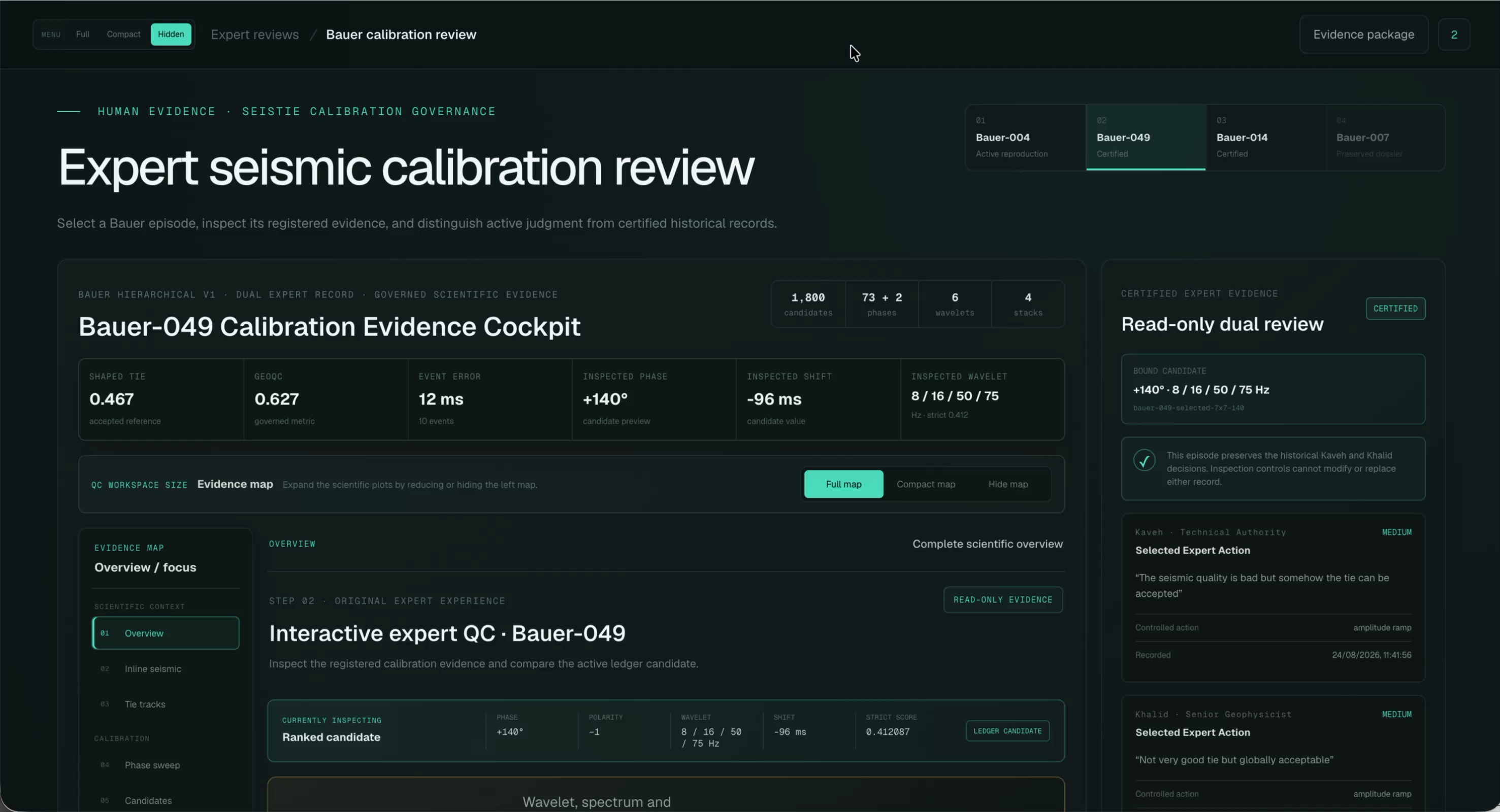
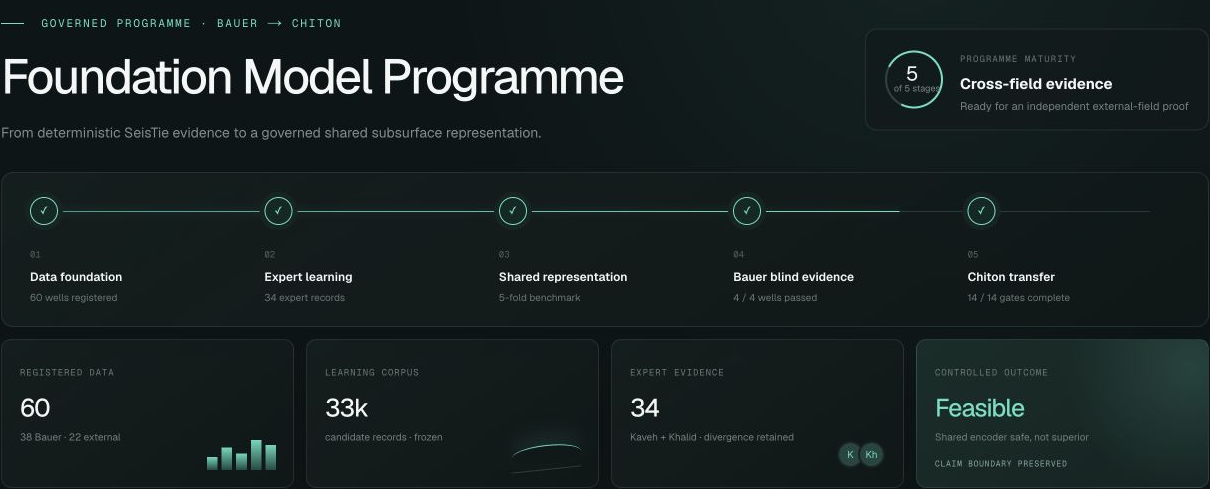
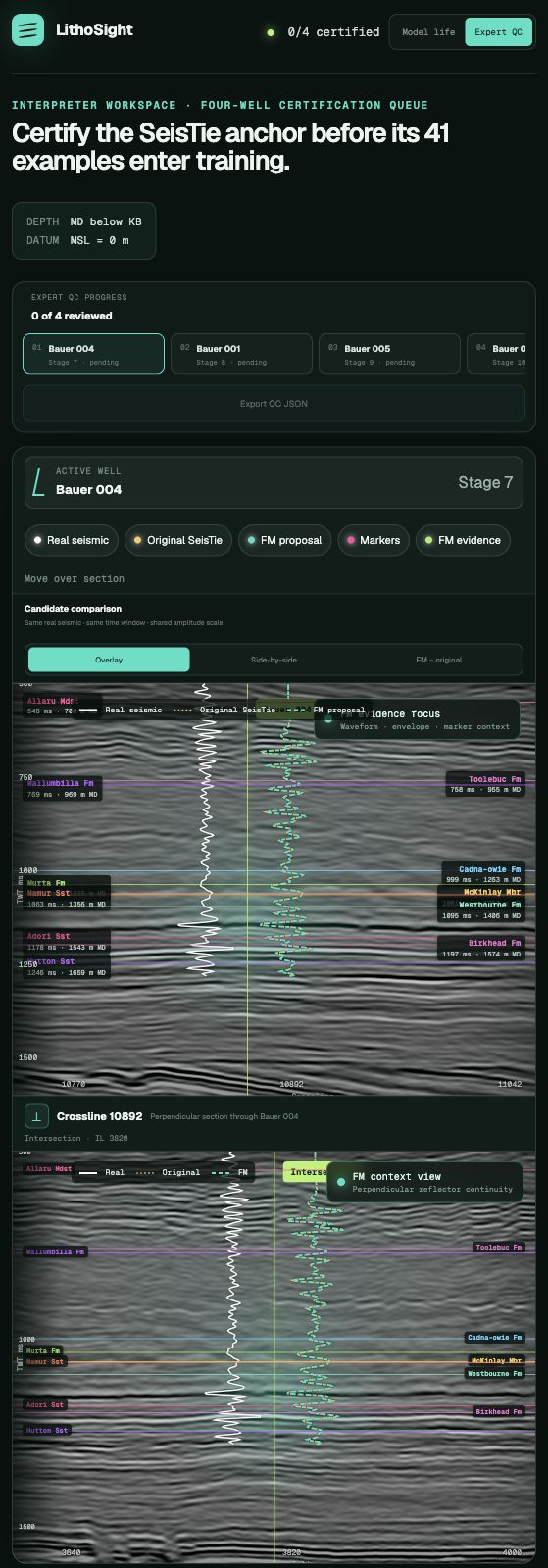
Expert feedback trained a model that improved calibration on wells excluded from its training. These Bauer results are the first proof that reviewed evidence can guide future work.
Median RMSE reduction on wells excluded from training.
Measured on wells with expert correction targets.
Median RMSE reduction on held-out wells.
Bauer proof of concept · held-out-well evaluation · calibration only. Broader geological transfer remains the next validation step.
Make advanced workflows easier to repeat, expert judgment easier to retain, and scientific quality easier to govern across a portfolio.
Extend advanced geoscience workflows across more wells and assets without making scarce expert time the limiting factor.
Keep portfolios current and become ready for short decision windows when new data, opportunities, or risks emerge.
Preserve the context, corrections, and reasoning that usually disappear when experts move or projects close.
Apply one evidence standard across projects while keeping uncertainty visible and expert accountability intact.
Test the intelligence system with us—or bring a defined geoscience challenge and use our in-house technology today.
Run a LithoSight engine on your data, capture expert feedback in Foundry, and test transfer against explicit success criteria.
LithoSight geoscientists use our in-house Interpret and Predict technologies to deliver a scoped technical result.
TieSight is the first engine—not the final product. Foundry creates a common way to capture judgment across adjacent workflows while preserving each method’s scientific core.
Physics-based seismic-to-well calibration with automated candidate search, transparent configuration, expert review, and full QC.
Resolve ambiguous events, correct horizons and faults, and capture the evidence and uncertainty behind each interpretation.
Evaluate starting models, review convergence, investigate unreliable updates, and reuse trusted calibration evidence.
Choose constraints, test consistency with wells, and keep geological plausibility and expert acceptance explicit.
Extend the same governed approach to porosity, facies, TOC, net-to-gross, saturation, and permeability.
Start with a defined calibration problem, keep the validation boundary explicit, and scale only when the evidence supports it.
Select the asset, data, expert reviewers, and success criteria.
Use TieSight across wells with complete configuration and QC.
Capture expert decisions and evaluate honestly on held-out data.
Expand across wells, basins, or engines when transfer is proven.
Prove the workflow on one asset—and shape what the foundation learns next.
Discuss a pilot